


Bridges are built to connect two shores, but today they are called to do much more. In the era of artificial intelligence, they become intelligent infrastructures: listening to what happens within their structure, reading signals, and responding in real time.
They are no longer just steel and concrete, but fully-fledged digital systems that, thanks to sensors and algorithms, monitor their own health, anticipate potential issues, and support more effective decision-making, enhancing safety and extending the lifespan of these structures.
1 – Genoa San Giorgio Bridge
The Genoa San Giorgio Bridge, built by Webuild, represents a new model of forward-looking public infrastructure, designed both to restore a strategic connection for the city and to monitor in real time the health of its various components.
The structure combines an essential engineering approach with durable materials and solutions conceived to ensure long-term reliability, featuring a steel-and-concrete deck engineered to withstand environmental stresses and heavy traffic.
A central element of this infrastructure project is the advanced monitoring system: a network of sensors and digital devices continuously tracks the bridge’s behaviour, collecting data on vibrations, loads, and structural conditions.

2 – Wuhan Yangtze River Bridge (China)
An example of a futuristic bridge is the Wuhan Yangtze River Bridge in China, where over a hundred sensors have been installed throughout the structure to monitor its health in real time.
These monitoring tools detect changes caused by earthquakes, vessel impacts, deck movements, and other critical phenomena, transmitting the data to a centralized platform that supports inspections, maintenance, and timely interventions.

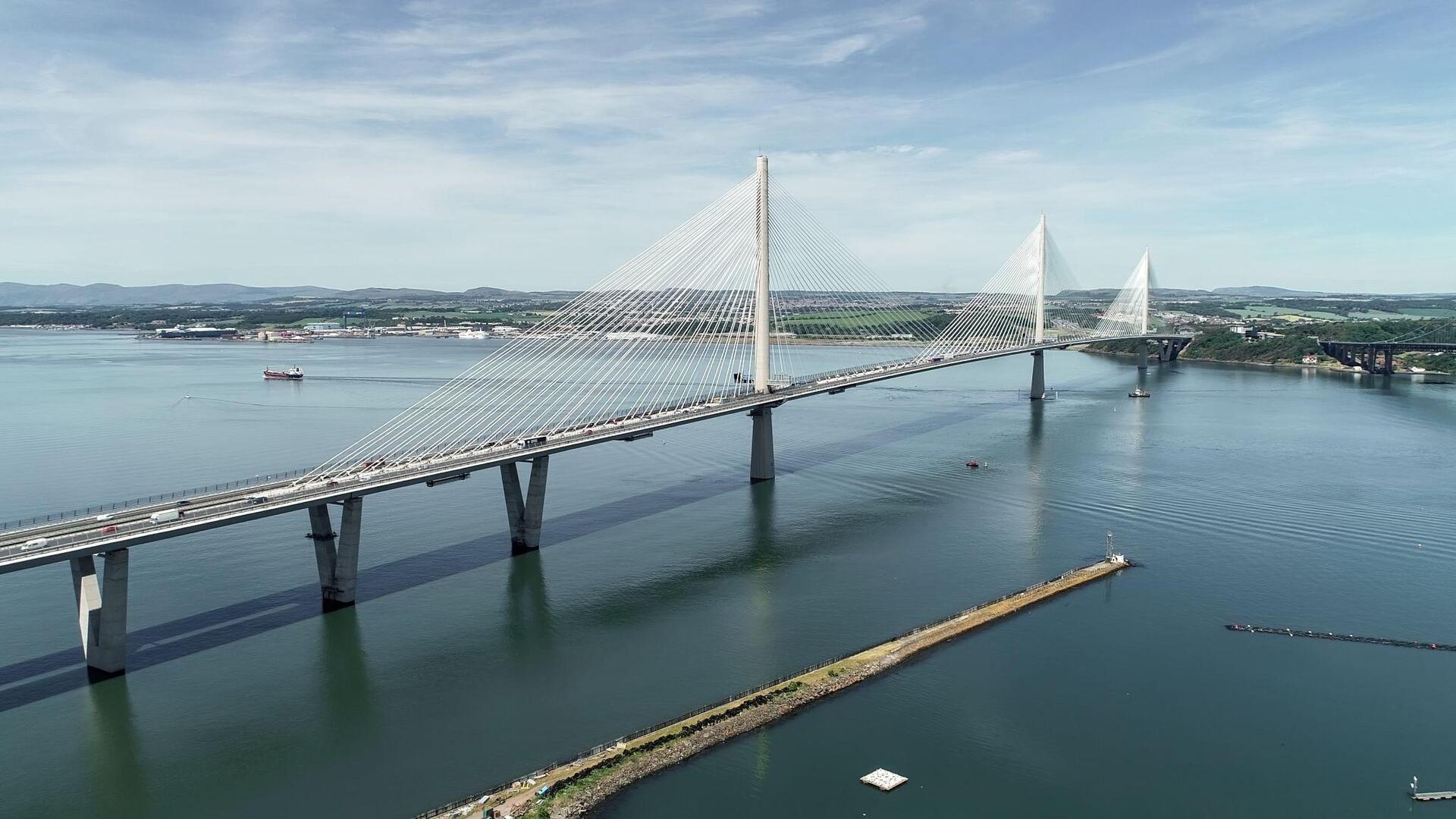
3 – Queensferry Crossing (Scotland)
Another example of a smart bridge is the Queensferry Crossing Bridge in Scotland, one of the largest three-tower viaducts in the world, equipped with a state-of-the-art structural monitoring system based on the Internet of Things, big data, and machine learning.
The bridge is monitored by nearly 1,900 sensors distributed across the entire structure, all connected to a digital platform that integrates real-time data on deformations, loads, environmental conditions, and traffic. This allows the bridge’s behaviour to be continuously and predictively analysed.
Through a digital model (Digital Twin), the data are compared with advanced simulations, providing a detailed overview of the structure’s health and enabling more targeted and efficient maintenance interventions before issues surface.
4 – Golden Gate Bridge (USA)
The Golden Gate Bridge, the famous bridge in California, has become an open-air laboratory for intelligent infrastructure monitoring.
Thanks to accelerometers and gyroscopes embedded in the smartphones of passing vehicles, researchers have been able to measure the bridge’s vibrations and modal frequencies, key indicators for structural health monitoring.
The data collected on the San Francisco bridge has demonstrated remarkable accuracy compared to traditional monitoring software, opening up new possibilities for more efficient predictive maintenance.

5 – Jindo Bridge (South Korea)
The Jindo Bridge in South Korea has become a testing ground for advanced structural monitoring tools thanks to the Illinois Structural Health Monitoring Project (ISHMP), a research initiative that deployed a wireless network of smart sensors on the bridge.
On this cable-stayed structure, one of the largest low-cost sensor networks ever used on an urban infrastructure was installed, with around seventy nodes distributed along the deck, pylons, and cables to collect real-time data on vibrations, wind, and loads.