


 Marrakech, Morocco
 Marrakech railway station
 Rabat, Morocco
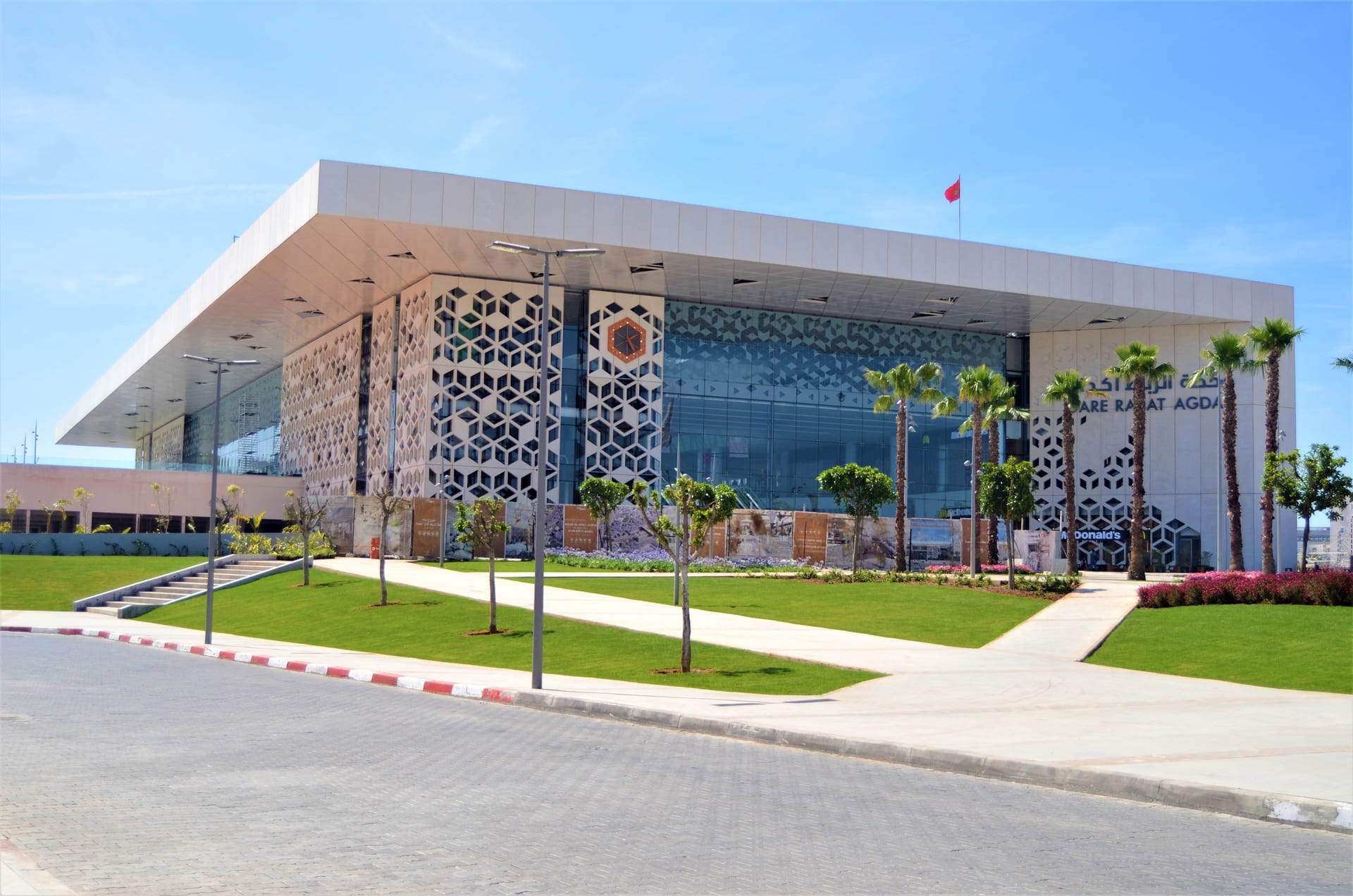 Rabat-Agdal train station, Morocco
 Prince Moulay Abdallah Stadium, Rabat
 Railway station with Al Boraq high-speed trains
 Tangier, Morocco
 Tangier-Ville railway station
 Tangier railway station
 Tangier Grand Stadium
 Tangier Med Harbour
 Casablanca, Morocco
 Casa-Voyageurs train station, Casablanca
 High-speed train at the station of Casa-Voyageurs in Casablanca
- Morocco accelerates on high-speed rail: more than 200 km of new line to Marrakech to complete the Tangier–Rabat–Casablanca corridor.
- The new line is expected to be completed in time for the 2030 Football World Cup.
- After the 2018 debut of the first high-speed line, Al Boraq — 350 km between Tangier and Casablanca — Rabat is extending the high-speed network southwards.
- The line to Marrakech is not merely a project for major events; it reduces distances, integrates labour markets and strengthens tourism and industry along the Kingdom’s most dynamic axis.
- The line represents an ideal extension of the TEN-T networks that the Webuild Group is building in southern Italy.

In 2030 Morocco will host the 2030 World Cup alongside Spain and Portugal. For Rabat, this is not merely a global sporting event but a strategic deadline that has accelerated a series of infrastructure investments set to leave a legacy far beyond the tournament itself. Among these, perhaps the most emblematic project is the extension of the high-speed rail line to Marrakech.
The objective is clear: to complete the Atlantic high-speed axis by extending southwards the railway line that currently links Tangier to Casablanca, creating a continuous corridor connecting the country’s principal cities. It is not simply an infrastructural extension, but a step change in the Kingdom’s territorial planning.
Morocco was in fact the first African country to equip itself with a high-speed trains, inaugurating the Al Boraq service in 2018 between Tangier and Casablanca. The overall route stretches for around 350 kilometres, more than 180 of which were built to high-speed rail standards, with trains running at up to 320 km/h between Tangier and Kenitra.
The impact on the organisation of economic space was immediate: journey times were almost halved, Tangier further consolidated its role as an industrial and logistics platform thanks to the Tanger Med port, while Rabat and Casablanca became even more closely integrated within a single, expanded metropolitan system.
World Cup 2030: High-Speed Trains in the Imperial City
The new phase of infrastructure development provides for the extension of high-speed rail to Marrakech, covering more than 200 kilometres along the southern Atlantic spine. The programme entails infrastructure investment amounting to several billion euros, because it is not simply a matter of building a faster railway line, but of reshaping the backbone of the country along an axis that concentrates the political capital, the economic capital and the tourism capital.
In the run-up to the 2030 FIFA World Cup, Marrakech represents a key hub for the country. It is one of Africa’s most important tourist destinations, boasts a high-capacity international airport and will be at the centre of event-related flows.
Connecting it swiftly and reliably to Rabat and Casablanca means ensuring a mobility system capable of handling millions of additional journeys, easing pressure on motorways and limiting reliance on domestic flights.
Yet the most significant legacy will be structural: once the FIFA World Cup 2030 is over, the railway line will continue to serve citizens, businesses and tourists, consolidating the country’s economic integration.
High-Speed Rail: A Development Strategy Rooted in the Past
Morocco’s strategy of investing in rail mobility did not begin with the 2030 World Cup. The national operator ONCF has for years pursued a modernisation plan aimed at strengthening the railway’s role as the backbone of national development.
High-speed trains represent its most visible and symbolic component, but it forms part of a broader system that includes upgrading conventional railway lines, refurbishing stations and integrating networks with logistics and port hubs. The overall design is consistent with Morocco’s industrial transformation, which over the past fifteen years has focused on manufacturing, automotive, aerospace and renewable energy.
In this context, high-speed rail is not merely a transport infrastructure but an instrument of territorial policy. Reducing distances between Tangier, Rabat, Casablanca and Marrakech means broadening the labour market, encouraging student mobility and attracting productive investment along the axis served by the line.
There is also an environmental dimension reinforcing the rail option. Morocco is one of the African countries most committed to the energy transition, with major investments in solar and wind power. In this scenario, a high-capacity electrified rail network makes it possible to reduce the carbon footprint of medium-distance transport by shifting traffic away from road and air to more sustainable modes. The coherence between energy policy and mobility infrastructure is one of the elements that make the project strategic well beyond the World Cup 2030 horizon.
European Transport: High-Speed Infrastructure Construction as a Tool for Development
The high-speed rail sector is today one of the most dynamic markets worldwide. The ability to design and build high-speed rail lines requires integrated expertise ranging from civil alignment works to technological systems, from the construction of long-span viaducts and tunnels to the management of complex worksites.
European experience shows that high-speed railway lines generate multiplier effects over the medium to long term, reshaping the distribution of economic activity and enhancing the competitiveness of connected areas.
In this field, the Webuild Group is among the leading international operators, drawing on experience gained in Italy and abroad across hundreds of kilometres of high-speed and high-capacity lines. Italy’s high-speed network, which transformed the Turin–Milan–Rome–Naples axis and now extends towards new routes such as Naples–Bari, stands as one of the most significant examples of how railway infrastructure can influence a country’s economic structure.
These are complex infrastructure projects involving major underground works, long-span viaducts and stations integrated into some of the most sensitive urban contexts.
From the TEN-T Networks to North Africa
It is precisely the Trans-European Transport Network (TEN-T), the dense web of high-speed rail lines linking European Union countries, that looks towards the Mediterranean and North Africa.
The Italian line extensions that the Webuild Group is currently delivering — from the Salerno–Reggio Calabria high-speed route to fast lines in Sicily — also aim to build an intermodal network of connections, from rail on the mainland to maritime crossings of the Mediterranean, ideally linking even the more developed countries of North Africa, including Morocco itself.
The high-speed rail line to Marrakech, which will be ready in time to welcome fans and delegations in 2030, nevertheless looks to a long-term horizon, capable of supporting and accompanying the economic and social transformation of the territory.
Connecting Tangier to Marrakech through a continuous high-speed corridor means strengthening the country’s economic unity, consolidating the competitiveness of its urban hubs and projecting Morocco into an infrastructural dimension consistent with its regional ambitions. From this perspective, the 2030 World Cup is not an end point but an intermediate milestone in a modernisation journey that, once again, runs along the railway.