


 "Futuro a vista" by Pierpaolo Ferrari at Piazza Venezia, Rome
 "Futuro a vista" by Pierpaolo Ferrari at Piazza Venezia, Rome
 "Futuro a vista" by Pierpaolo Ferrari at Piazza Venezia, Rome
 "Futuro a vista" by Pierpaolo Ferrari at Piazza Venezia, Rome
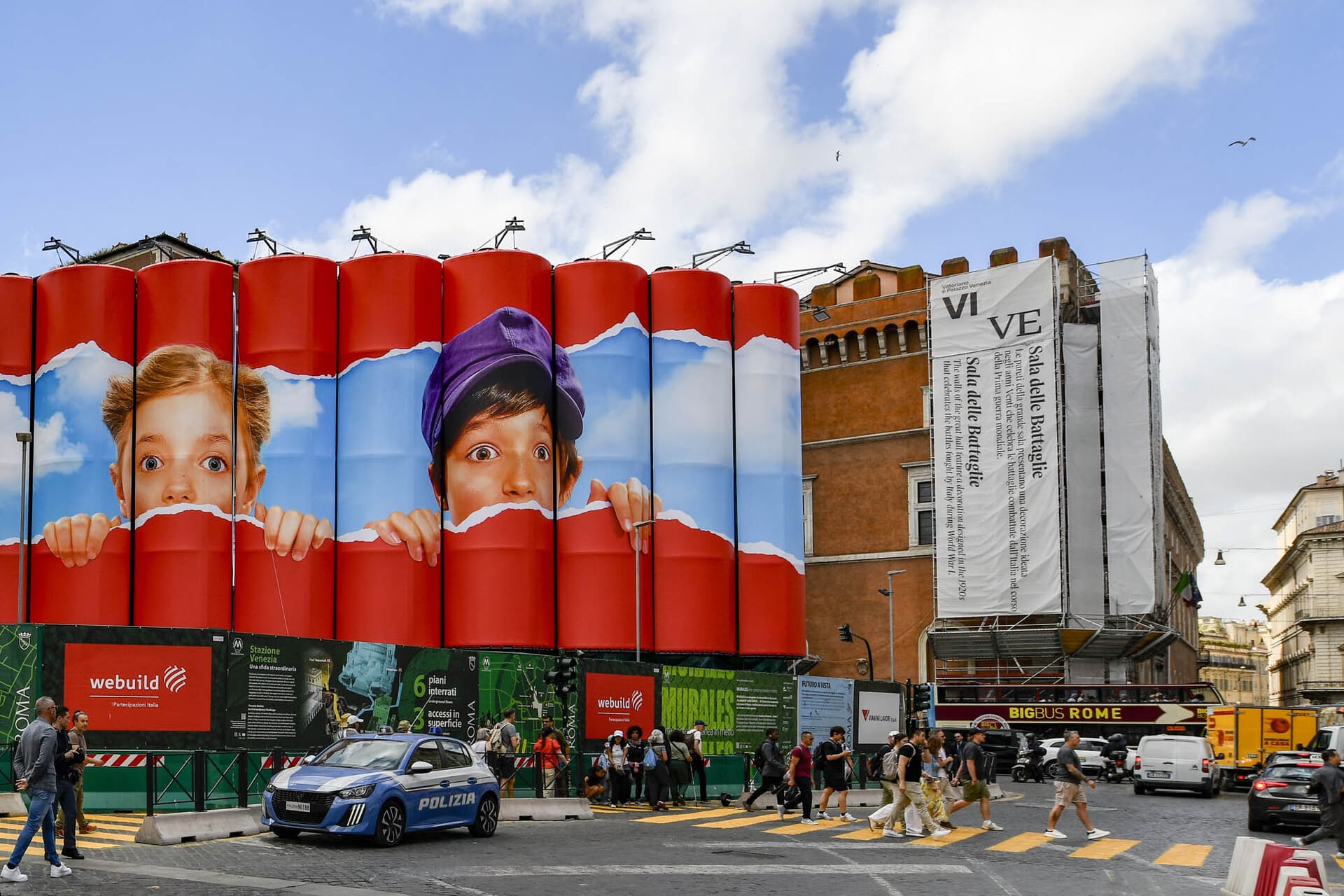 "Futuro a vista" by Pierpaolo Ferrari at Piazza Venezia, Rome
- “Futuro a vista” transforms the Rome Metro Line C construction site into a symbolic window onto the Capital’s future
- The work accompanies the construction of Line C, the driverless metro built by the Consorzio Metro C led by Webuild and Vianini Lavori
- On the silos of the future Venezia station, Murales brings contemporary art into the heart of Rome’s urban transformation
- Pierpaolo Ferrari narrates Rome’s transformation through two children looking out onto the city’s future
- With 24 metro stations already in operation, Line C will connect the historic centre of Rome to Farnesina, crossing the heart of the Capital
read more

The construction site of the Rome Metro Line C has once again been transformed into a public open-air cultural space. “Futuro a vista”, the work by Pierpaolo Ferrari—an internationally renowned artist and photographer and co-founder, together with Maurizio Cattelan, of Toiletpaper magazine—is the fourth installation in the Murales project, the initiative launched by the Consorzio Metro C, led by Webuild and Vianini Lavori, which turns the site’s silos into an enormous exhibition space.
Rome thus continues to tell its future starting from its cultural heritage. And it does so in the most symbolic place of the urban transformation currently underway in the Capital: Piazza Venezia, where the vast Metro Line C construction site once again becomes an open-air art gallery.
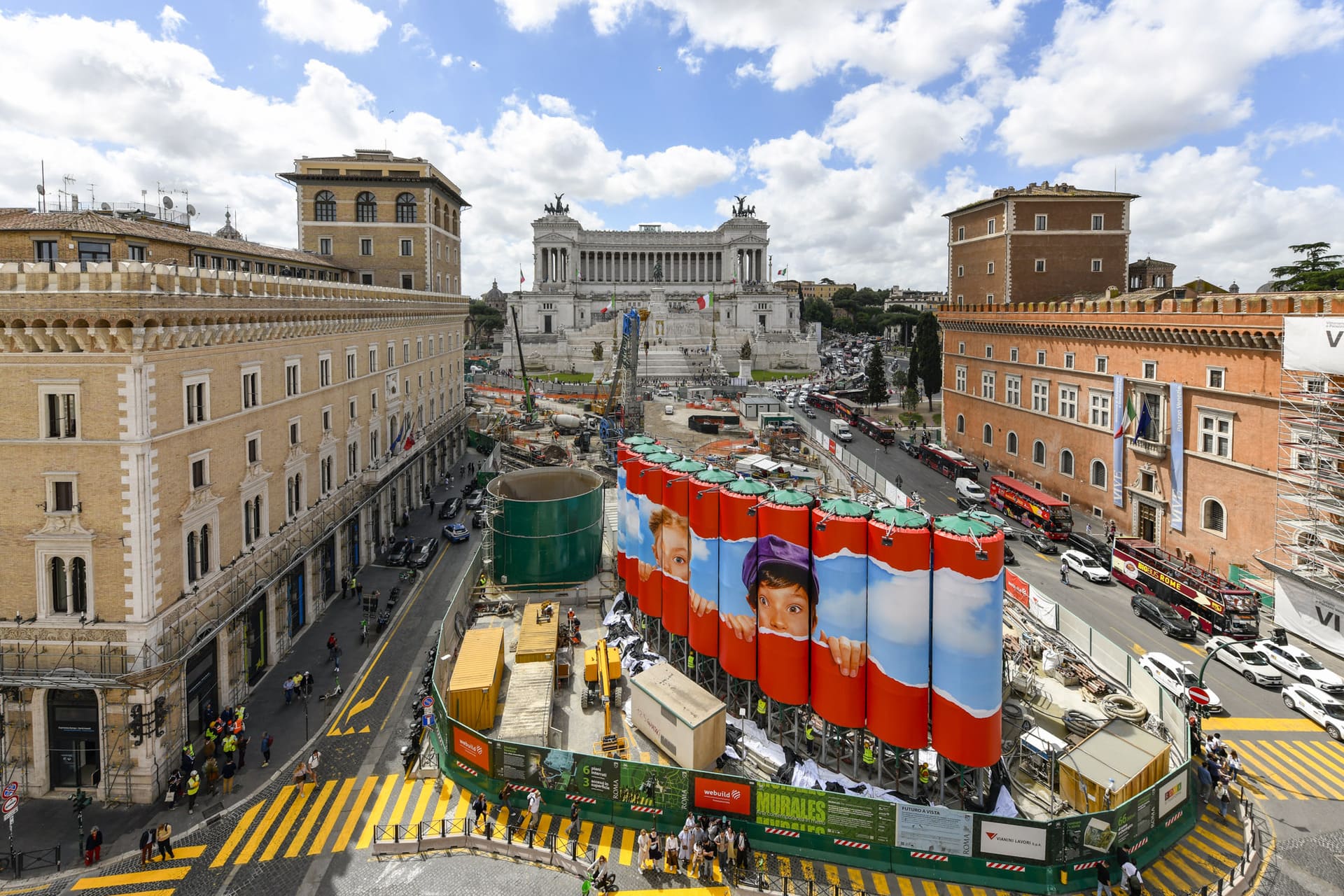
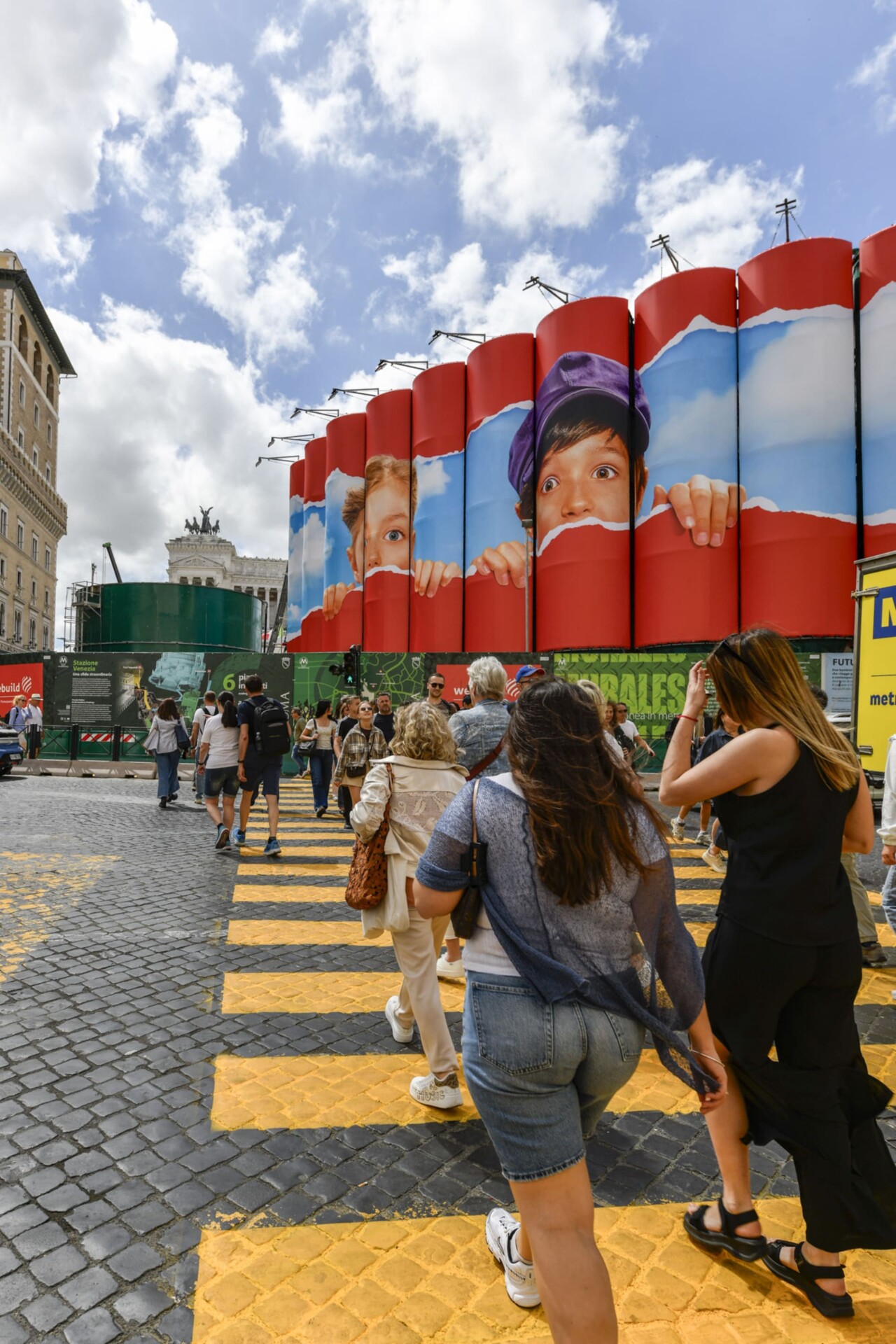
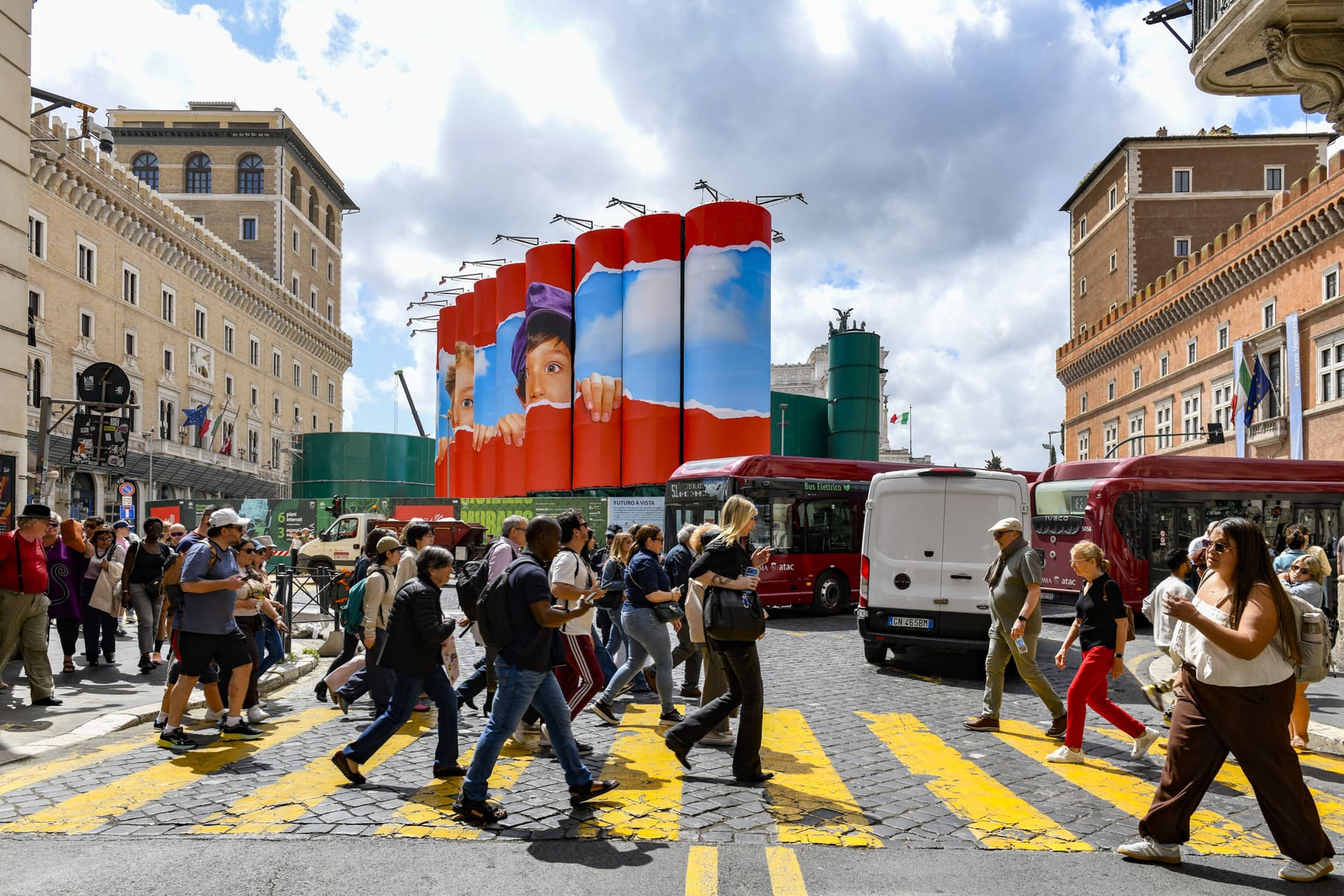
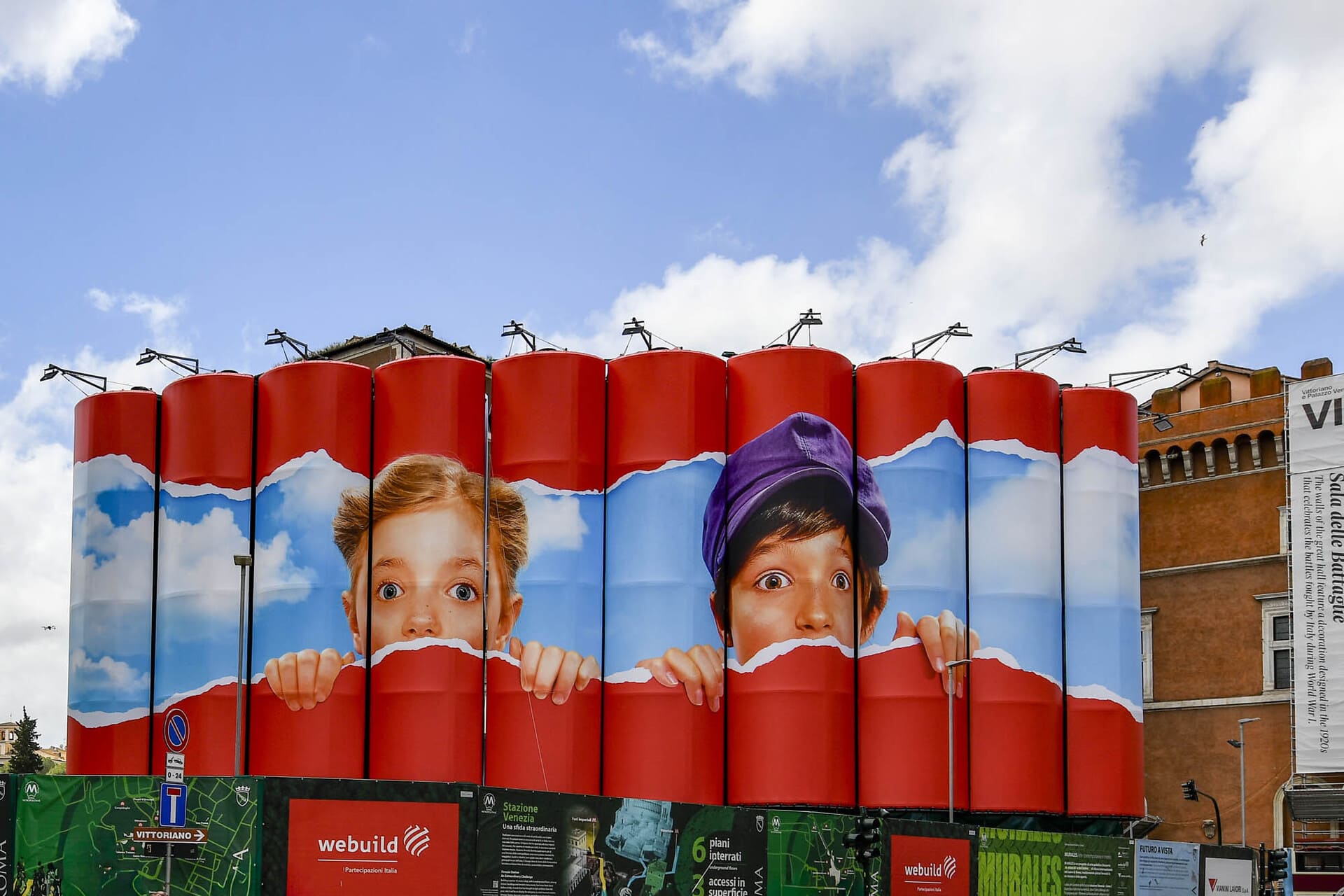
“Futuro a vista”, the new work in the Murales project, covers an area of approximately 600 square metres and transforms the construction site into a large symbolic threshold overlooking the city’s future. At the centre of the composition are two children observing Rome through a tear in the site’s covering. Their wide-open eyes seem to be looking at something that does not yet exist, but which is taking shape right beneath the square.
Pierpaolo Ferrari in Piazza Venezia: The Child’s Gaze as a Metaphor for Change
The protagonist of Pierpaolo Ferrari’s image is therefore childhood and its privileged perspective on change. The two children become observers of urban transformation, unwitting witnesses to a city that is evolving.
Through their eyes, the construction site loses its function as a barrier and becomes an opening, a space for connection, a window onto possibility. No longer a closed place separated from everyday life, but an element integrated into the city’s urban and cultural fabric.
The scene engages directly with Piazza Venezia, with the constant flow of residents, tourists, buses, taxis and scooters that pass every day through one of the Capital’s key hubs. The city itself becomes a permanent spectacle, observed through a gaze that is both simple and extraordinarily powerful: that of children.
Murales: The Metro Line C Construction Site Transformed into a Cultural Platform
“Futuro a vista” represents the fourth chapter of the Murales project, the initiative that from 2024 to 2026 is transforming the construction site of the Venezia station on the Rome Metro Line C into a major urban cultural platform for urban art.
The aim of the project is to reinterpret the construction site as a contemporary exhibition space, entrusting the silos and large surfaces of the site to Italian artists of international standing capable of engaging with themes of the city, urban transformation and public space.
Before Pierpaolo Ferrari, the project hosted Pietro Ruffo with “Costellazioni di Roma”, Marinella Senatore with “Ci eleviamo sollevando gli altri”, and Elisabetta Benassi with “Tools”, a work that transformed workers’ tools into symbols suspended between the sacred dimension and everyday life.
The project is guided by a Scientific Committee composed of some of Italy’s most important cultural institutions: the Galleria Nazionale d’Arte Moderna e Contemporanea, MAXXI, the Galleria Borghese and the Palazzo delle Esposizioni. A choice that reinforces Murales’ ambition: to transform Piazza Venezia into one of Europe’s most innovative laboratories for dialogue between infrastructure, contemporary art and urban regeneration.
Rome Metro Line C: Infrastructure Transforming Public Transport in the Capital
Behind the artwork, the vast construction site for Metro Line C continues, one of the most complex and strategic infrastructure projects currently under construction in Europe.
Line C is the third line in Rome’s metro network and also the capital’s first driverless metro line. It currently connects the south-eastern quadrant of the city to the Imperial Fora station, with 24 stations already completed and approximately 21 kilometres of track in operation. The line already allows interchange with Line A at San Giovanni and with Line B at Colosseo/Fori Imperiali.
The overall Line C project envisages a route of approximately 29 kilometres and 31 stations, from Montecompatri/Pantano to Clodio/Mazzini, with the possibility of a further extension towards Farnesina.
The future section crossing the historic centre of Rome will extend the line from Venezia to Mazzini, passing beneath the Tiber and including the new metro stations Chiesa Nuova, Piazza Pia/Castel Sant’Angelo, Ottaviano and Mazzini. An extension destined to profoundly transform Rome’s public transport system, creating new urban connections between the historic centre and the city’s peripheral districts.
The Piazza Venezia station therefore represents one of the most complex and symbolic nodes of the entire project. Conceived as a true “archaeo-station”, it will be built in a unique context, among archaeology, historical stratifications and advanced engineering technologies. The project aims to integrate sustainable mobility with the enhancement of archaeological heritage, transforming the station into a museum space open to the city.
Contemporary Art and Infrastructure: A New Idea of the City
In this context, Murales takes on a meaning that goes beyond a simple artistic installation. The project conveys a different idea of infrastructure: not only a technical work designed to improve urban mobility, but also a public space capable of generating cultural relationships, imagination and participation.
It is a vision that transforms the construction site into a shared narrative space. Public art thus becomes a tool to accompany urban change, helping citizens and visitors to interpret the city’s transformation as it happens.
With “Futuro a vista”, Rome adds a new piece to this collective narrative. And it does so by choosing a simple and universal image: two children looking out towards tomorrow, observing a city that is changing before their eyes.